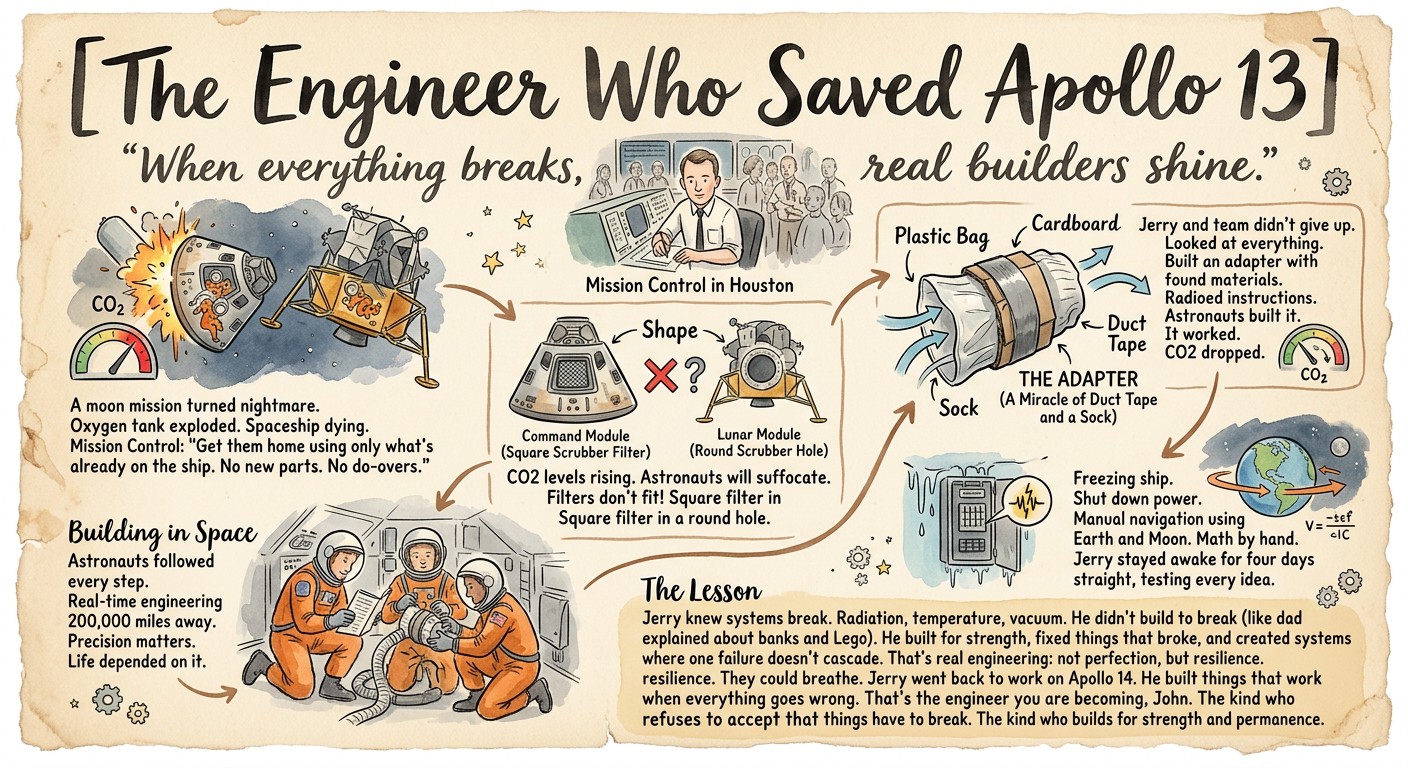
The Engineer Who Saved Apollo 13
When everything breaks, real builders shine
I dreamed about something that happened in space in 1970. Three astronauts were heading to the moon when an oxygen tank exploded. Everything broke at once. The spaceship was dying. Mission Control in Houston said they had to figure out how to get the crew home alive using only what was already on the ship. No new parts. No do-overs. Just what they had.
There was this one engineer named Jerry Woodfill. He wasn't famous. He didn't get movies made about him. But he knew every single system on that spacecraft because he'd helped build it. When everyone else was panicking, Jerry started thinking like you do when you build. What works? What's broken? What can we use differently than it was designed for?
The carbon dioxide scrubbers were failing. The astronauts were breathing out CO2 faster than the ship could clean it. They'd suffocate in hours. The problem? The command module had square scrubbers. The lunar module had round ones. They didn't fit together. It's like having the wrong Lego piece and no way to make it work.
Jerry and his team didn't give up. They looked at everything on board. Plastic bags. Cardboard. Duct tape. A sock. They built a completely new adapter using only what the astronauts could find floating around. They radioed up instructions. The astronauts built it exactly right, following every step. It worked. The CO2 levels dropped. They could breathe.
But that wasn't the only thing breaking. The ship was freezing because they shut down power to save battery. Water condensation was shorting out electrical panels. The navigation system was offline. They had to manually steer using the Earth and moon as reference points, doing math by hand that computers usually handled.
Jerry stayed awake for four days straight. He tested every idea. He didn't assume anything would work just because it should. He checked. When something failed, he didn't get mad at the designers or blame the materials. He just found another way.
The thing that gets me, John, is this: Jerry knew those systems would break eventually. Everything in space breaks. Radiation, temperature swings, vacuum pressure—it all destroys materials over time. But Jerry built with that knowledge. He didn't design things to break on purpose, like testing systems to find flaws. He designed things that could be fixed, adapted, rebuilt with whatever was available.
That's the difference between planned obsolescence and real engineering. Real engineers like Jerry accept that failure happens, so they build in ways to recover. They don't hide weak points. They document them. They create systems where one failure doesn't cascade into total collapse.
When Apollo 13 finally splashed down in the ocean, all three astronauts were alive. Jerry didn't get a parade. He went back to work on Apollo 14. Because for him, it wasn't about being a hero. It was about building things that work even when everything goes wrong.
Jerry proved that when you understand how things actually work, not just how they're supposed to work, you can save lives. You can bring people home. You can build something that lasts even when the universe is trying to destroy it.
That's the kind of engineer the world needs. The kind who refuses to accept that things have to break. The kind who builds for strength and permanence. Just like Jerry Woodfill, sitting in Mission Control with duct tape and cardboard, saving three lives 200,000 miles away.
← All Dreams